 Sentrly
How VPN Encryption Works (Without the Math Headache)
What ‘AES-256’, ‘WireGuard’, and ‘perfect forward secrecy’ actually mean.
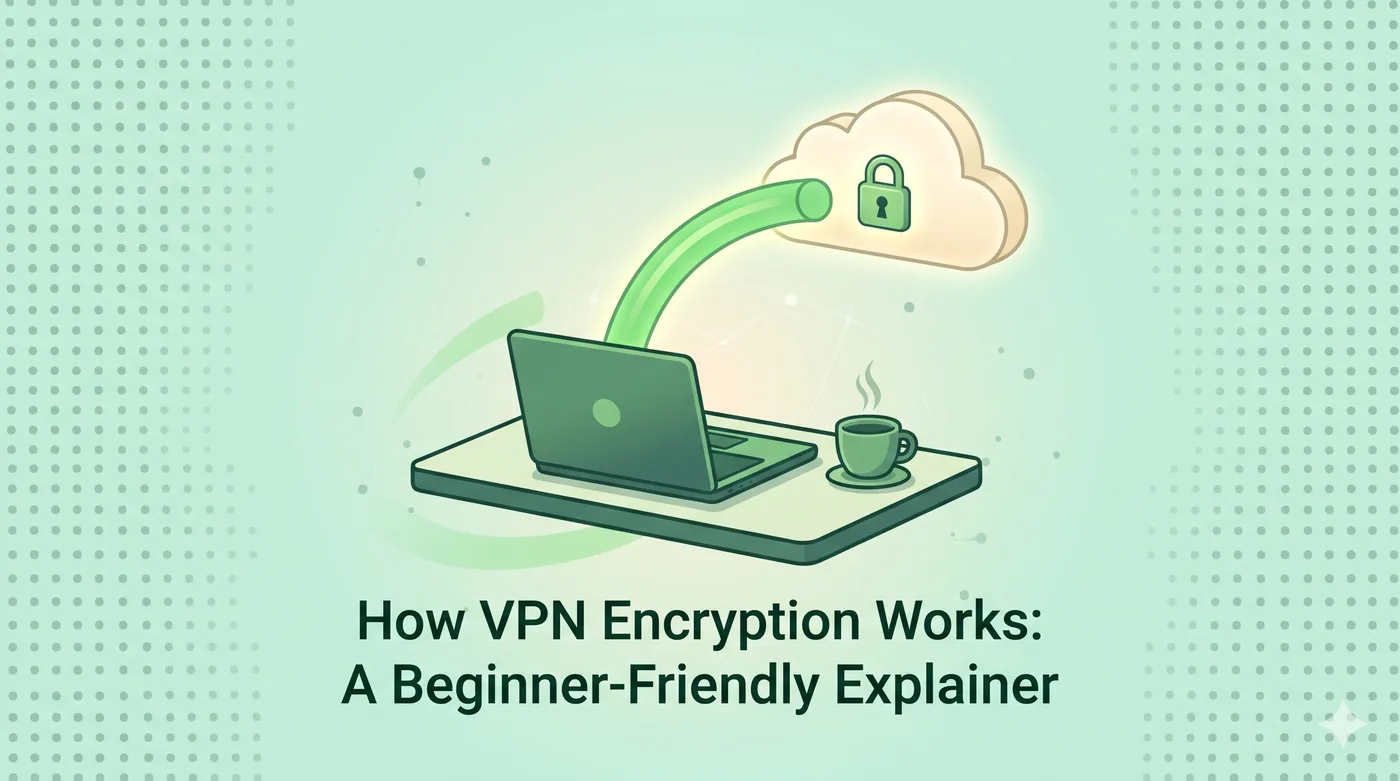
VPN encryption works by wrapping your internet traffic in a layer of unreadable code before it leaves your device. The VPN server holds the matching key, decrypts the traffic, and forwards it to the wider internet. Anyone watching in between only sees scrambled data.
Key takeaways
- A VPN tunnel uses two pieces: a key-exchange step and a bulk-encryption step.
- AES-256 and ChaCha20 are the two ciphers you’ll see most often — both are strong.
- WireGuard is faster and simpler than OpenVPN and is now the modern default.
- ‘Perfect forward secrecy’ means past traffic stays safe even if a key is later stolen.
The big picture
Encryption is the process of turning readable information into something only the holder of the right key can read. A VPN does this in two stages. First, your device and the VPN server agree on a temporary shared secret. Then they use that secret to encrypt the actual traffic.
Step 1: the handshake
When you press ‘connect’, your client and the server perform a key exchange — usually based on elliptic-curve cryptography. Neither side ever transmits the secret directly; they each compute it from numbers exchanged in the open. This is what makes intercepted traffic unhelpful to an attacker.
Step 2: bulk encryption
Once the handshake is done, every packet you send is encrypted with a fast symmetric cipher — AES-256 in OpenVPN/IKEv2, ChaCha20-Poly1305 in WireGuard. These ciphers are fast enough that you won’t notice them on modern hardware.
What ‘AES-256’ actually means
AES is the Advanced Encryption Standard, chosen by the U.S. government in 2001 after a public competition. The ‘256’ is the key length in bits. There is no known practical attack against properly-implemented AES-256 — the weak point in any VPN is almost always somewhere else, like the user’s password or the provider’s logging.
Why WireGuard changed things
WireGuard is a newer protocol with a tiny code base — about 4,000 lines vs OpenVPN’s 100,000+. Less code means fewer places for bugs to hide. It also tends to connect faster and use less battery on phones.
Frequently asked questions
Is AES-256 ‘military grade’?
‘Military grade’ is a marketing phrase. AES-256 is the standard the U.S. government approved for TOP SECRET data, but every reputable VPN uses it — so it’s not a differentiator.
Can the VPN provider see my traffic?
Yes — the VPN server decrypts your traffic before forwarding it. That is why a no-logs policy and an independent audit matter so much.
What does ‘zero-knowledge’ mean for a VPN?
It usually means the provider claims not to retain logs that could link a user to their browsing. Look for third-party audits before believing the claim.
Related guides
VPN for Public Wi-Fi Safety: A Complete 2026 Guide
How a VPN protects you on coffee-shop, airport, and hotel Wi-Fi — and where it doesn’t help.
Read article →VPN vs Proxy: The Real Differences (And When to Use Each)
Both hide your IP address. Only one encrypts your traffic. Here’s how to choose.
Read article →VPN Best Practices for Remote Work and International Travel
A practical checklist for digital nomads, frequent fliers, and remote teams.
Read article →