 Sentrly
VPN vs Proxy: The Real Differences
Both hide your IP address. Only one encrypts your traffic. Here’s how to choose.
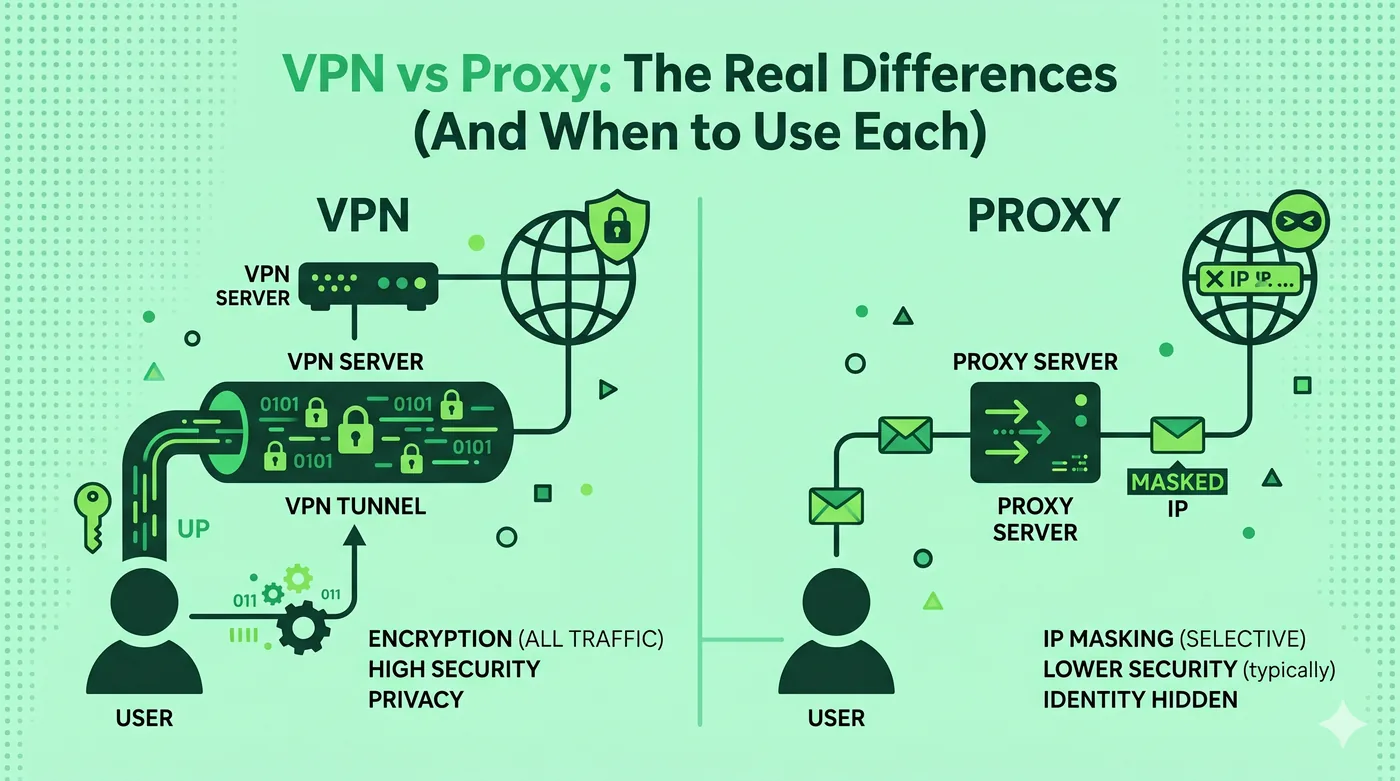
A VPN encrypts and routes all of your device’s traffic through a remote server, while a proxy only redirects traffic from a specific app or browser and usually does not encrypt it. Use a VPN for privacy and security; use a proxy for narrow tasks like web testing or geo-checking.
Key takeaways
- VPNs work at the operating-system level; proxies work at the app level.
- Most proxies do not encrypt traffic — anyone on your network can still read it.
- Proxies are usually faster and cheaper for narrow technical tasks.
- For everyday personal privacy, a VPN is the better default.
The one-sentence difference
A VPN encrypts every byte your computer sends and receives; a proxy is a relay that forwards specific traffic — usually unencrypted — and changes the IP address that the destination sees.
Where each one makes sense
VPNs shine when you want one toggle to protect your whole device — phones, laptops, smart TVs. Proxies shine when you only need to change the apparent location of a single browser tab, run a price-comparison script, or test a website from another country.
What about ‘HTTPS proxy’ or ‘SOCKS5 over TLS’?
Some proxies do support encryption. The point is you have to opt in and configure it; with a VPN, encryption is the default. If you want defaults that are safe for non-experts, use a VPN.
A quick decision table
Need to protect your phone on hotel Wi-Fi → VPN. Need to scrape product prices from 12 countries → datacenter proxy pool. Need to watch a stream from a different country occasionally → either, but a VPN is simpler. Need to keep your work laptop’s traffic separated from personal → VPN with split tunnelling.
Frequently asked questions
Is a proxy faster than a VPN?
Often yes, because there’s no encryption overhead — but the speed difference on a fast home connection is usually small.
Can I chain a VPN and a proxy?
Yes, technically. Most people don’t need to; it just adds latency and points of failure.
Are free proxies safe?
Public free proxy lists are notoriously risky. Many inject ads or strip HTTPS. Treat them as untrusted.
Related guides
VPN for Public Wi-Fi Safety: A Complete 2026 Guide
How a VPN protects you on coffee-shop, airport, and hotel Wi-Fi — and where it doesn’t help.
Read article →How VPN Encryption Works: A Beginner-Friendly Explainer
What ‘AES-256’, ‘WireGuard’, and ‘perfect forward secrecy’ actually mean.
Read article →VPN Best Practices for Remote Work and International Travel
A practical checklist for digital nomads, frequent fliers, and remote teams.
Read article →