 Sentrly
Deepfake voice scams: how to spot a cloned voice
AI voice cloning has crossed the indistinguishable threshold. Here's how to detect a synthetic voice and what to do when a 'family member' calls in distress.
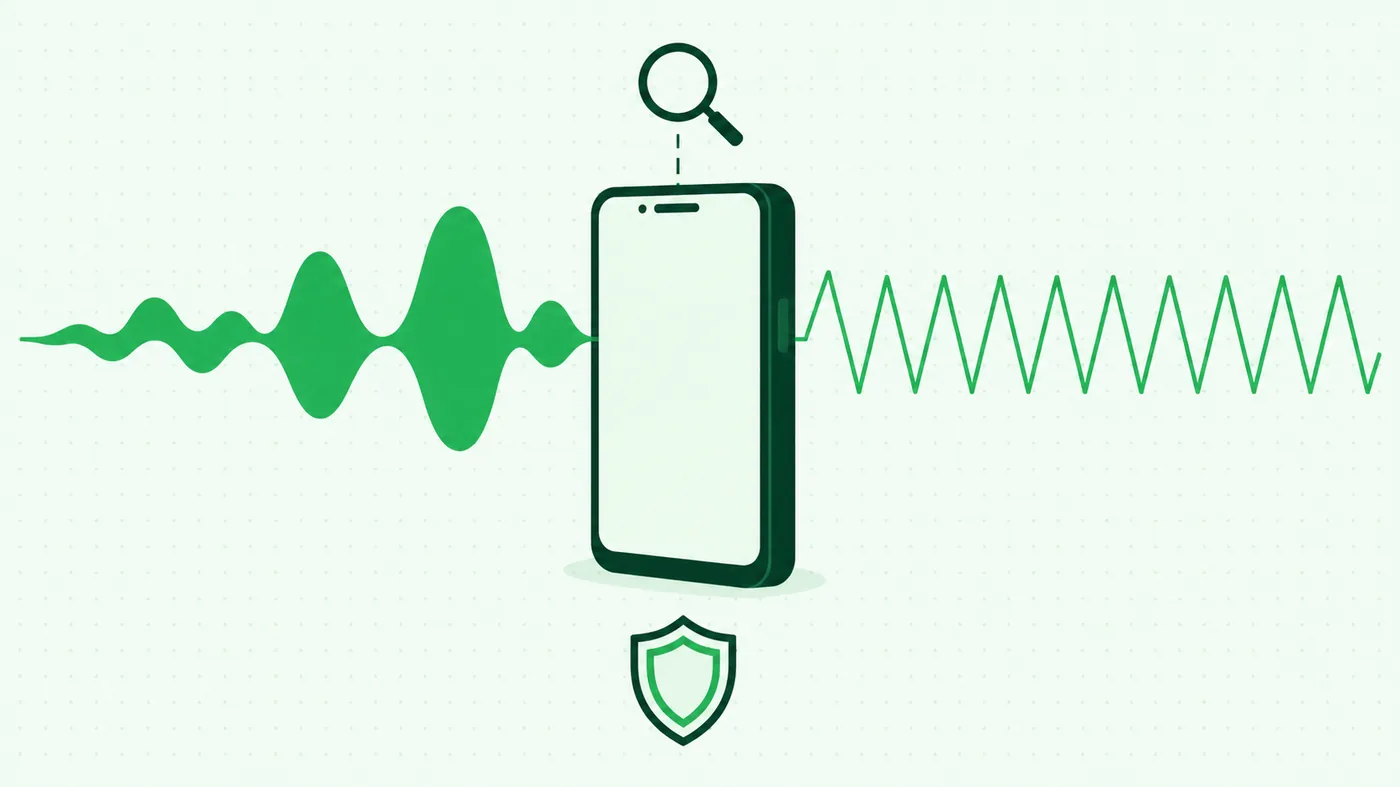
Treat any urgent, emotional phone call asking for money or credentials as suspicious — even when the voice is recognizable. AI can now clone a voice from 3 seconds of audio. Defend by hanging up and calling the person back on a number you already have, by agreeing on a family safe-word now, and by knowing the tells of synthetic speech: unnatural rhythm, no breathing pauses, perfect grammar under stress, and lack of background noise.
Key takeaways
- Voice cloning crossed the indistinguishable threshold in late 2025 — human listeners can no longer reliably tell real from fake.
- Any urgent call that triggers fear and asks for money, credentials, or codes should be hung up and called back on a verified number.
- Agree on a family safe-word that no one outside the household knows — and use it any time a relative calls in distress.
- AI voices have a 'metronome' rhythm, no genuine breathing pauses, and lack the imperfections of real human speech.
- Lock down your social media — voice samples for cloning are usually pulled from public videos, voicemails, and podcast appearances.
What changed in 2026
AI voice cloning was a curiosity in 2023. By late 2025 it had crossed what researchers call the 'indistinguishable threshold' — meaning a trained ear can no longer reliably tell a synthetic voice from a real one in normal conversation. Modern tools need only 3 to 30 seconds of source audio to produce a convincing clone, and that audio is trivially gathered from public videos, voicemail greetings, podcast clips, or a brief 'Hello?' answered on a spam call.
Group-IB's High-Tech Crime Trends Report 2026 documented a 194% surge in voice-deepfake fraud attempts across Asia-Pacific from 2024 to 2025. The U.S. FBI and the UK's National Crime Agency both issued public warnings in early 2026. The most common scenario is the 'grandparent scam, supercharged' — a fake call from a child or grandchild claiming to be in an accident, in jail, or kidnapped, demanding immediate money.
The five tells of a synthetic voice
No real human breathes perfectly. Synthetic voices often have a metronome-like rhythm — every syllable evenly spaced, no genuine pauses for breath. If a panicked relative is speaking in flowing, evenly-paced sentences without audible inhalation, that is suspicious.
Real distressed speech is messy. People stumble, repeat words, swallow, sigh, take ragged breaths. Cloned voices often deliver clean, well-formed sentences even when the script says they are crying — because the model was trained on clear audio, not on actual distress.
Background noise often does not match the claimed location. A 'daughter at a police station' should have hold music, footsteps, distant voices, fluorescent buzz. Pristine studio-quality audio coming from a chaotic situation is a red flag.
Watch for vocabulary drift. AI clones the timbre of a voice but not the speaker's actual habits. If the 'caller' uses words your relative would never use, or sounds suddenly more formal or articulate than usual, take note.
Pressure to act now. Almost every successful AI voice scam relies on the same lever: don't think, act now, the danger is immediate. Real emergencies allow callbacks. Fake ones don't.
What to do when a suspicious call arrives
Stop and breathe. Tell the caller you'll call them back. Hang up.
Call your relative on the number you have saved in your phone. Not the number that just called you. If they don't answer, try a different family member.
Use your pre-agreed safe-word if you have one. (See the next section.)
Do not accept any pressure tactic that asks you to stay on this line. A real emergency room, police station, or attorney is happy to receive a callback from a verified number.
Set a family safe-word today
Pick a phrase that no one outside the immediate family knows. Not a pet's name, not a birthday — those are often public. Pick something arbitrary: 'green tractor,' 'salt and pepper,' a line from a private joke.
Share it in person, not over text or email. Don't store it in cloud-synced notes.
Use it any time someone in the family calls in distress and asks for money, credentials, or sensitive information. If they can't produce it, treat the call as a deepfake until proven otherwise.
Reduce your voice attack surface
Voice samples are scraped from public sources. The fewer minutes of your voice are publicly available, the harder you are to clone.
Set social-media videos to friends-only or remove old ones with significant talking.
Use a generic outgoing voicemail greeting. 'Please leave a message after the tone' from a stock voice is fine — your name, in your voice, is not.
On work calls, be aware that recorded webinars, podcast guest spots, and conference talks are public training data.
What detection tools actually do
Detection tools like Deeptrace, Reality Defender, and Microsoft's Video Authenticator analyze acoustic patterns invisible to humans — spectral artefacts left by the generation model. They are useful for enterprises and journalists, but they are not yet a consumer-friendly real-time defense.
Google's SynthID watermarks AI-generated audio at the point of creation. It only works for content made with cooperating AI tools — most scam audio is generated with open-source or non-cooperating tools.
Treat detection tools as a forensic aid after the fact, not a safety layer during a live call. Your live defense is the callback rule and the safe-word.
Frequently asked questions
How long does an AI need of my voice to clone it?
Modern systems can produce a usable clone from 3 to 30 seconds of clean audio. Higher-quality clones use 1 to 3 minutes. Voicemail greetings, social-media videos, and podcast appearances are common sources.
Can my bank's voice authentication be fooled?
Yes. Multiple banks have rolled back voice-biometric authentication in 2025–2026 specifically because deepfakes defeat it. Treat any service that authenticates you by voice alone as weakly secured, and add a second factor where possible.
What if the call shows the right number on caller ID?
Caller ID is trivially spoofed. A matching number means nothing — assume it's spoofed and call back on the saved number. Don't tap 'call back' from the call log; that uses the spoofed number.
Should I record the suspicious call?
If you can without revealing it, yes — recordings help law enforcement and detection services. Many phones can record calls with a tap; check your jurisdiction's consent laws before relying on this.
Are video calls safer than voice calls?
Less than they used to be. Real-time deepfake video on a Zoom-style call cost engineering firm Arup $25.6 million in early 2024. Treat 'I can see them' as no proof of identity. Use the safe-word.
Related guides
Phishing Attacks: How to Spot and Avoid Them in 2026
The single most common way ordinary people lose money online — and how to recognise it.
Read article →Two-Factor Authentication: A Complete Beginner’s Guide
The single most effective security upgrade most people can make in five minutes.
Read article →Password Manager Best Practices in 2026
Choose, set up, and live with a password manager without locking yourself out.
Read article →